


Reading Passage:
Word Count: 143 words
Hawker centres are the heart of Singapore’s food culture. Finding an empty table during the busy lunch hour is often a challenge. However, the real frustration begins when you finally spot a seat, only to find the table littered with dirty bowls, used tissues, and food spills.
To tackle this issue, the mandatory Tray Return Scheme was introduced. Diners are now required to clear their tables and return their used crockery to designated stations after their meals. While it took some time for everyone to adjust, the benefits are clear.
Returning our trays shows consideration for the next diner and helps the cleaners, who are often elderly, manage their workload. It also prevents pests like birds and insects from feeding on the leftovers. By taking a few extra seconds to clear up, we can all enjoy a cleaner and more pleasant dining environment.
PSLE Oral Practice: Stimulus-Based Conversation (TREE Method)
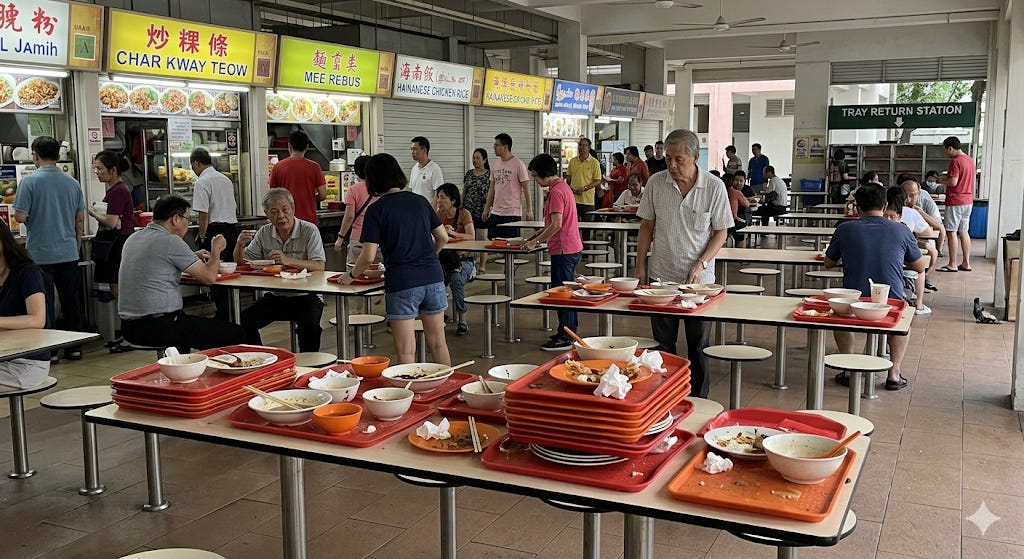
Question 1: Examiner Question: "Look at the picture of this messy hawker table. How does this scene make you feel, and why do you think some people still do this?"
The TREES Response Strategy:
T - Thought (Your Opinion): Looking at this picture makes me feel incredibly frustrated and disappointed.
R - Reason (Why you feel this way): I feel this way because leaving a table in such a dirty state is highly inconsiderate to the next diner and creates an unnecessary burden for the cleaners. It shows a lack of civic-mindedness.
E - Example (Point to the picture): For example, in the photograph, we can clearly see stacked trays, dirty bowls with leftover food, and used tissues left behind, even though there is a large ‘Tray Return Station’ sign visible right in the background! It shows people are choosing convenience over responsibility.
E - Experience (Your personal story): Personally, I have experienced this many times. Just last month, during a busy Sunday lunch, my family and I had to clear someone else’s dirty plates and wipe up a spilled drink with our own wet wipes just so we could sit down. It was very unhygienic and almost ruined our appetite.
S - Suggestion (How to fix it - The High-Score Maker!): To improve this situation, I suggest that besides the current fines, we could have “Tray Return Ambassadors” stationed at busy hawker centres during peak hours. A friendly, gentle reminder from an ambassador right as diners are finishing their meals might be more effective in turning this into a natural habit for all Singaporeans.
Examiner Question 2: “Tell me about a time you showed consideration for others in a public place.”
The TREES Response Strategy:
T - Thought (Your Opinion): I strongly believe that showing consideration for others in public is a basic responsibility we all share as Singaporeans.
R - Reason (Why you feel this way): When we are mindful of how our actions affect others, it creates a much more pleasant, safe, and harmonious environment, especially in our crowded city.
E - Example (A general scenario): Simple acts of consideration can include holding the lift door for your neighbours, keeping your volume down on the MRT, or, of course, returning your tray after a meal.
E - Experience (Your personal story): Personally, I showed consideration just last week on my way home from school. I was sitting on a crowded bus when an elderly woman carrying heavy grocery bags boarded. Without hesitating, I stood up and offered her my seat. She smiled warmly and thanked me. Even though my legs were tired, seeing her rest comfortably made me feel genuinely happy.
S - Suggestion (How to encourage others): To encourage more students to be considerate, I suggest that schools could introduce a “Public Kindness Challenge.” Students could be tasked with completing three considerate acts in public over the weekend. Sharing these positive stories during morning assembly would inspire others to do the same and build a culture of kindness.
thanks. please like and shares.
Thanks. please share with your friends. we hope people can shares free notes not pay for simple thing