


Reading Passage:
140 Words
Singapore’s Park Connector Network is a wonderful shared space for everyone. On any given evening, you will see families strolling, joggers keeping fit, and cyclists commuting. However, this beautiful environment can quickly become dangerous when people do not follow the rules.
Recently, there has been a worrying increase in reckless behaviour along these paths. Some cyclists ride against the flow of traffic, weaving dangerously close to pedestrians. Others speed blindly around sharp corners, completely ignoring the safety signs. This inconsiderate behaviour puts vulnerable users, such as young children and the elderly, at serious risk of injury.
To ensure our paths remain safe and enjoyable, it is crucial that all users exercise patience and civic-mindedness. Cyclists must keep to their designated lanes and observe the speed limits, while pedestrians should stay alert. By showing mutual respect, we can prevent unnecessary accidents.
PSLE Oral Practice: Stimulus-Based Conversation (PEEL Method)
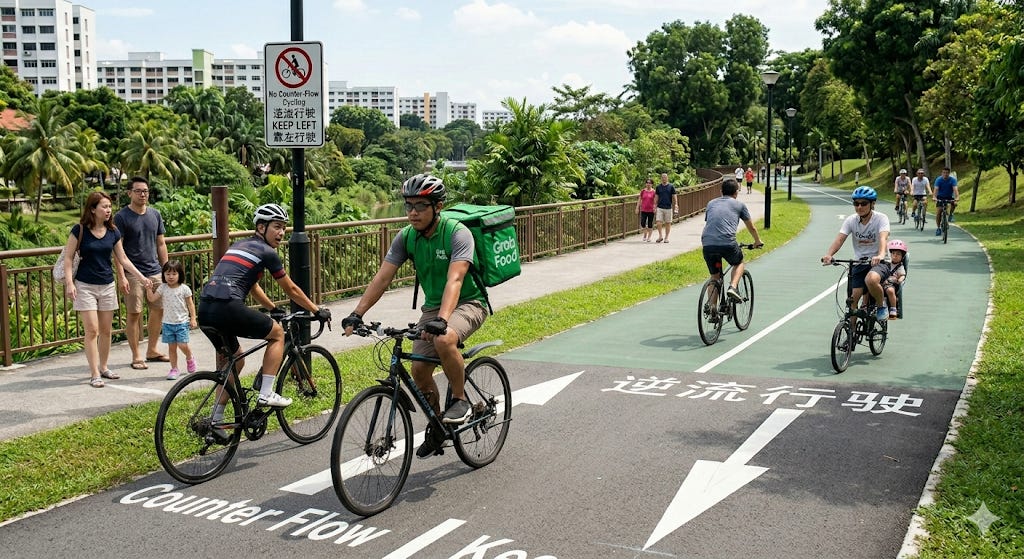
Question 1: Look at the picture. How do you feel about the behaviour of the two cyclists in the foreground?
T - Thought (Your Opinion): I feel very concerned and quite frustrated by their behaviour.
R - Reason (Why you feel this way): They are acting recklessly and endangering not only themselves but also the vulnerable pedestrians sharing the path.
E - Example (Point to the picture): For example, in the picture, we can clearly see the two cyclists—including a food delivery rider who should know better—cycling directly against the large white directional arrows painted on the ground. They are also completely ignoring the prominent “No Counter-Flow Cycling” sign on the lamppost right next to them! This forces the family walking nearby to be on high alert.
E - Experience (Your personal story): I have witnessed this happen before on my own neighbourhood PCN. A speeding cyclist riding on the wrong side almost collided with a young boy who was stepping out from a park bench. It was a very jarring and scary experience for everyone around.
S - Suggestion (How to fix it): To stop this, I suggest that the authorities increase the frequency of patrols by enforcement officers during peak hours. If riders who intentionally break the rules face immediate fines, it will serve as a strong deterrent.
🗣️ Question 2: Tell me about a time when you witnessed or experienced someone being inconsiderate in a public space.
T - Thought (Your Opinion): I strongly believe that public spaces belong to everyone, so we must all play our part to be considerate.
R - Reason (Why you feel this way): When people act selfishly, it ruins the environment for others and can even cause unnecessary conflict or physical danger.
E - Example (A general scenario): Inconsiderate behaviour can range from listening to loud music on the MRT without earphones, to leaving trash behind at a park bench.
E - Experience (Your personal story): Personally, I experienced this just last week at a shopping mall. I was waiting for the lift with my grandmother, who uses a walking stick. When the doors opened, a group of teenagers rushed in before letting the people inside exit, and they didn’t even offer space for my grandmother. We had to wait for the next lift.
S - Suggestion (How to encourage others): To improve this, I suggest that schools organize more empathy-building workshops or role-playing activities during Character and Citizenship Education (CCE) lessons, so students can truly understand how their actions affect vulnerable members of society.
🗣️ Question 3: In your opinion, what can be done to encourage everyone to share public paths safely?
T - Thought (Your Opinion): In my opinion, encouraging the safe sharing of paths requires a mix of better infrastructure and impactful community education.
R - Reason (Why you feel this way): Sometimes people break rules because they are rushing, but other times it’s because the culture of safety isn’t strong enough yet.
E - Example (Link to the theme): As we can see in the picture, even with clear signs and painted arrows, some people still choose to ignore them for their own convenience.
E - Experience (Personal connection): When my school organized a road safety assembly, a traffic police officer shared real-life dashcam footage of accidents caused by reckless riding. Seeing the actual consequences made a huge impact on me and my friends, much more than just reading a poster would have.
S - Suggestion (The Big Solution): Therefore, I suggest launching a nationwide “Share the Path” campaign that uses social media to show the real-life dangers of counter-flow cycling. Additionally, the government could widen paths in high-traffic areas and use physical dividers, like small planters or raised curbs, to permanently separate cyclists from pedestrians.