


Reading Passage:
144 words
Taking public transport is a daily routine for most Singaporeans. During peak hours, trains and buses are often packed to the brim with exhausted commuters rushing to their destinations. In such cramped spaces, it is easy to become entirely focused on our own comfort.
Unfortunately, this self-absorption sometimes leads to inconsiderate behaviour. It is a common, yet disheartening, sight to see young, healthy individuals glued to their smartphones while occupying the designated priority seats. Meanwhile, elderly passengers, pregnant women, or those feeling unwell are left to struggle with their balance as the vehicle jerks and moves.
We must remember that a gracious society starts with small, daily acts of kindness. Simply looking up from our screens and offering a seat to someone in need can make a world of difference. True civic-mindedness is about looking out for the vulnerable, even when we are tired.
PSLE Oral Practice: Stimulus-Based Conversation (TREES Method)
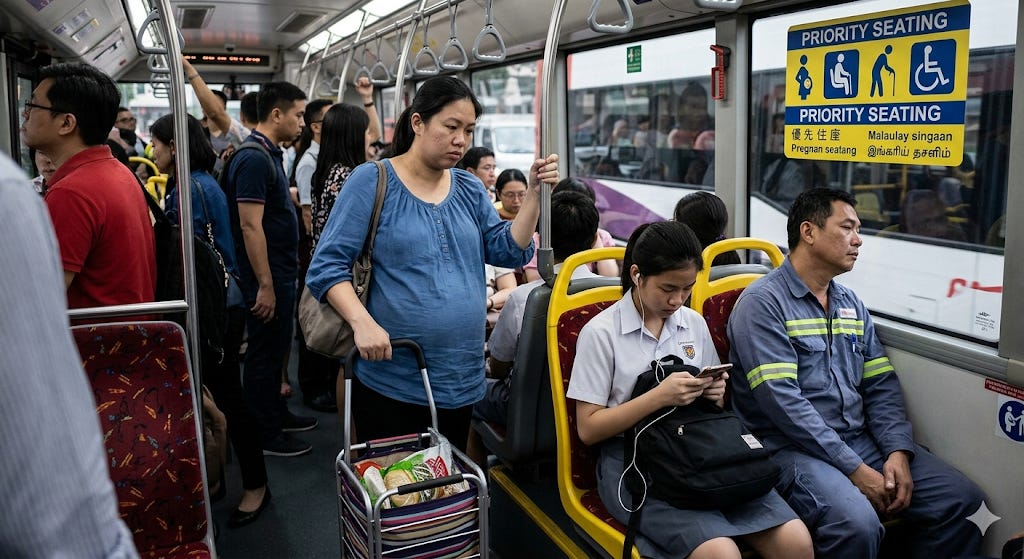
Question 1: Look at the picture. What are your thoughts on the behaviour of the passengers sitting in the priority seats?
T - Thought (Your Opinion): I am highly disappointed and upset by their complete lack of empathy.
R - Reason (Why you feel this way): Priority seats are specifically meant for vulnerable commuters who physically need them more than we do. Ignoring someone in need shows a severe lack of civic-mindedness.
E - Example (Point to the picture): For instance, in the photograph, we can clearly see a visibly pregnant mother struggling to balance while holding onto a grocery trolley. Yet, the teenager in the priority seat is completely oblivious, staring at their smartphone with earphones plugged in, while the other adult appears to be sleeping. They are completely ignoring her presence.
E - Experience (Your personal story): I have seen similar situations on the MRT. Once, an elderly man with a walking stick boarded a crowded train, but the people in the reserved seats pretended not to notice him. It made me feel very uncomfortable, and I ended up giving him my regular seat instead.
S - Suggestion (How to fix it): To prevent this, I suggest that public transport operators implement louder, more frequent audio announcements directly above the priority seating areas during rush hours, gently reminding passengers to look up and offer their seats to those in need.
🗣️ Question 2: Tell me about a time you gave up your seat or helped someone on public transport.
T - Thought (Your Opinion): I believe that helping others on public transport is a basic courtesy that everyone should practice instinctively.
R - Reason (Why you feel this way): Small acts of kindness not only ensure the safety of vulnerable passengers but also make our crowded daily commutes much more pleasant for everyone.
E - Example (A general scenario): Helping can be as simple as giving up a seat, helping someone carry a heavy stroller up the bus steps, or making space for a wheelchair user.
E - Experience (Your personal story): Personally, I experienced this a few months ago on my way to school. I was sitting at the back of a very bumpy, crowded bus when a mother boarded with a crying toddler and several heavy bags. Without hesitation, I stood up, walked over, and offered her my seat so she could safely settle her child. She looked incredibly relieved and thanked me repeatedly. It made me feel proud to be able to help.
S - Suggestion (How to encourage others): I suggest that parents and schools actively praise children when they display such considerate behaviour. When kids are rewarded with positive reinforcement for giving up their seats, it becomes a lifelong natural habit rather than a forced rule.
🗣️ Question 3: In your opinion, why do some people ignore those in need on public transport, and should there be fines for not giving up priority seats?
T - Thought (Your Opinion): In my opinion, most people ignore those in need not out of malice, but because they are trapped in their own digital bubbles; however, I do not think fines are the best solution.
R - Reason (Why you feel this way): People are often exhausted after a long day of work or school, and they use their phones to zone out. Fining them might create a very hostile and tense environment on our public transport.
E - Example (Link to the theme): Just like the teenager in the picture, when someone has earphones in and is staring at a screen, they lose all spatial awareness and genuinely do not notice the pregnant woman standing right beside them.
E - Experience (Personal connection): I admit that I have also been deeply engrossed in reading a book on the bus and almost missed seeing an elderly person board. It happens to the best of us when we are distracted.
S - Suggestion (The Big Solution): Therefore, instead of fines, I suggest a campaign focused on “Digital Disconnection.” We could have posters encouraging commuters to ‘Look Up Every Stop.’ If we can train people to simply pause their music and look around for five seconds every time the bus doors open, I believe Singaporeans are naturally kind enough to offer their seats voluntarily.