


Reading Passage:
130 words
Singapore’s blue recycling bins are a familiar sight in our neighbourhoods, designed to make recycling convenient for everyone. Unfortunately, these bins are often misused. Instead of clean paper, plastic, and glass, they are frequently treated as regular rubbish chutes.
It is not uncommon to find unflattened cardboard boxes piled high, or worse, half-eaten food and liquid waste thrown inside. This inconsiderate behaviour contaminates genuine recyclables, rendering the entire bin’s contents useless. It also creates a messy and unhygienic environment, attracting pests like rats and cockroaches.
Recycling is a shared responsibility, not a dumping exercise. To truly protect our environment, we must take the time to rinse out our bottles and fold our boxes. A little extra effort from each of us ensures our estates remain clean and green.
PSLE Oral Practice: Stimulus-Based Conversation (TREE Method)
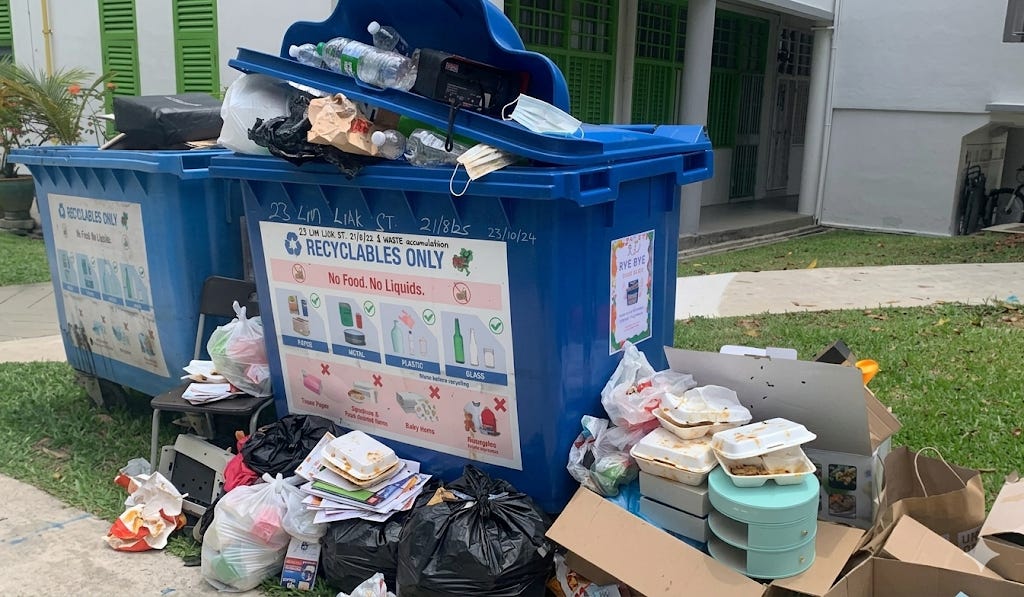
Question 1: Look at the picture. How does the sight of these recycling bins make you feel, and why?
T - Thought (Your Opinion): Looking at this picture makes me feel incredibly frustrated and disappointed.
R - Reason (Why you feel this way): I feel this way because the bins are meant to help protect the environment, but inconsiderate behaviour has turned them into a public hygiene hazard.
E - Example (Point to the picture): For example, in the photograph, we can see that people have simply dumped large, unflattened cardboard boxes in and around the bins. Because the boxes take up so much space, the bins are overflowing, and items are scattered all over the grass. It is messy and completely ignores the clear “Recyclables Only” sign.
E - Experience (Your personal story): I have unfortunately seen this at my own HDB void deck, especially after the festive seasons or major online sales. People dump food wrappers and even half-empty drink cups into the blue bins. This contaminates the clean recyclables and attracts pests like cockroaches and rats.
S - Suggestion (How to fix it): To solve this, I suggest that town councils place large, visual infographics right above the bins showing step-by-step how to flatten a box. If people see how easy it is to break down cardboard, they might be more willing to do it instead of just dumping it.
🗣️ Question 2: Tell me about a time when you or your family actively participated in recycling or protecting the environment.
T - Thought (Your Opinion): I strongly believe that protecting the environment must start at home with daily, consistent habits.
R - Reason (Why you feel this way): If every household does their small part to reduce waste, it creates a massive positive impact on our country’s limited landfill space.
E - Example (A general scenario): Good environmental habits include bringing our own reusable bags to the supermarket or switching off electrical appliances when they are not in use.
E - Experience (Your personal story): Personally, my family has set up a small “recycling corner” in our kitchen. Just last week, after we finished a bottle of pasta sauce and a plastic milk jug, I made sure to wash them thoroughly with soap and water to remove all the food residue. Then, I dried them before taking them down to the blue recycling bin.
S - Suggestion (How to encourage others): To encourage more students to recycle correctly, I suggest that schools introduce a “Recycling Champion” points system. Classes that consistently bring in clean, properly sorted recyclables could win a small prize at the end of the term. This makes recycling fun and educational.
🗣️ Question 3: The news article states these bins are being temporarily removed because they are “messy and unhygienic.” In your opinion, is removing the bins the best solution to this problem?
T - Thought (Your Opinion): In my opinion, while temporarily removing the bins might solve the immediate hygiene issue, it is not the best long-term solution.
R - Reason (Why you feel this way): Removing the bins entirely punishes the responsible residents who actually recycle properly, and it means all that recyclable waste will end up in the Semakau Landfill instead.
E - Example (Link to the theme): As we can see from the mess in the picture, the root cause of the problem isn’t the bins themselves, but a lack of civic-mindedness and education about “recycling contamination.”
E - Experience (Personal connection): When I talk to some of my neighbours, I realize that many people genuinely do not know that a greasy pizza box or a dirty plastic container cannot be recycled. They throw it in thinking they are helping, but they are actually ruining the whole batch.
S - Suggestion (The Big Solution): Therefore, instead of removing the bins, I suggest we replace them with “Smart Recycling Bins.” These machines require residents to scan their EZ-Link cards and they weigh the clean recyclables to give points that can be used for grocery vouchers. When people are rewarded for recycling correctly, they will naturally stop treating the blue bins like regular rubbish chutes.