


Reading Passage:
140 words
HDB playgrounds have always been the heart of our neighbourhoods. For generations, these vibrant spaces echoed with the joyful laughter of children playing catching, climbing the monkey bars, or simply running around with their friends. It was a place where friendships were forged and energy was well spent.
However, a quick glance at any playground today reveals a changing scene. While some children still enjoy physical activities, it is increasingly common to see others sitting quietly on the benches, their eyes glued to the glowing screens of their smartphones. They are physically present, yet entirely absorbed in their digital worlds, oblivious to the fun happening just steps away.
While technology offers endless entertainment, we must not forget the importance of outdoor play. Putting down our devices allows us to stay active, breathe in the fresh air, and build real-life connections.
PSLE Oral Practice: Stimulus-Based Conversation (5W1H Method)
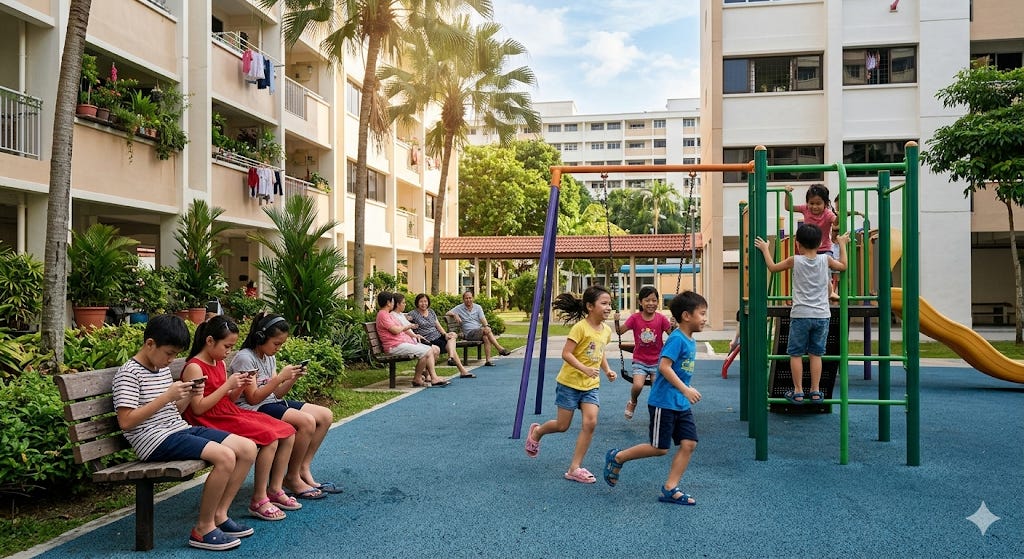
🗣️ Question 1: Look at the picture. Would you rather join the children on the playground equipment or the children sitting on the bench?
(This question tests observation and personal choice. Use 5W1H to give a complete explanation!)
Who (am I joining): I would definitely choose to join the children who are actively playing on the playground equipment, rather than those sitting on the bench.
What (will I be doing): I would love to climb the monkey bars, go down the slide, or play a game of catching with them.
Where (is this happening): At this vibrant HDB playground right below the flats.
Why (am I choosing this): I am choosing this because after sitting in a classroom all day, my body needs to move. Staring at a smartphone screen would just make my eyes more tired.
How (does it make me feel): Playing actively makes me feel energetic and refreshed. Looking at the children on the bench, I feel it is a pity that they are missing out on the fresh air and the chance to make new friends.
🗣️ Question 2: Tell me about a time you had a memorable experience playing outdoors.
(This question asks for a personal recount. 5W1H is the BEST way to tell a story without getting stuck!)
When & Where (Setting the scene): During the last December school holidays, my family and I went to East Coast Park for an entire afternoon.
Who (was with me): I was there with my parents and my siblings.
What (happened): Instead of bringing our iPads, we rented bicycles and cycled all the way from the East Coast Seafood Centre to the Marina Barrage. After that, we flew a kite that we had built ourselves.
Why (was it memorable): It was memorable because the wind was very strong that day, and our kite flew higher than everyone else’s. We had to work as a team to keep it steady.
How (did it end/feel): By the end of the day, my legs were completely exhausted from the cycling, but my heart was full. It made me realise that real-life outdoor adventures are far more exciting than any mobile game I could play on my phone.
🗣️ Question 3: In your opinion, how can parents encourage their children to spend less time on their devices?
(This question asks for a broader opinion/solution. 5W1H helps to break down a big idea into practical steps.)
Who (is responsible): I believe both parents and children need to work together to solve the problem of screen addiction.
What (needs to be done): Parents need to set clear and firm boundaries regarding screen time.
When (should this happen): For example, there could be a rule of “No phones at the dinner table” or a strict limit of one hour of screen time after homework is completed.
Where (can they go instead): To replace the screen time, parents should bring their children out to nearby nature parks, sports facilities, or the library.
Why (is this important): This is crucial because excessive screen time not only ruins our eyesight and posture, but it also stops us from developing important communication skills.
How (can it be successful): It will be successful if parents also act as good role models. If parents put away their own phones and actively play board games or go for walks with their children, the children will naturally follow their lead and forget about their devices.
we have move on to http://psleoral.sg please visit us and shares for this coming and next year
It is very helpful