


Reading Passage:
151 words
The sun sparkled on the gentle waves as the Primary Five students prepared for their first kayaking adventure. Lined up along the sandy shore, they adjusted their bright red life jackets and gripped their paddles tightly. For many, it was their first time venturing out into the open sea, and a buzz of excitement filled the air.
“Listen up, everyone!” Instructor Kamal called out, wading waist-deep into the water to steady a green kayak. “Remember to paddle together. If you do not synchronise your movements with your partner, you will end up going in circles. Communication is the key to moving forward.”
Sitting at the front of the kayak, Leo felt a flutter of nerves. He took a deep breath, dipped his paddle into the cool water, and called out a steady rhythm. Slowly but surely, the kayak glided away from the shore, leaving a trail of white foam behind.
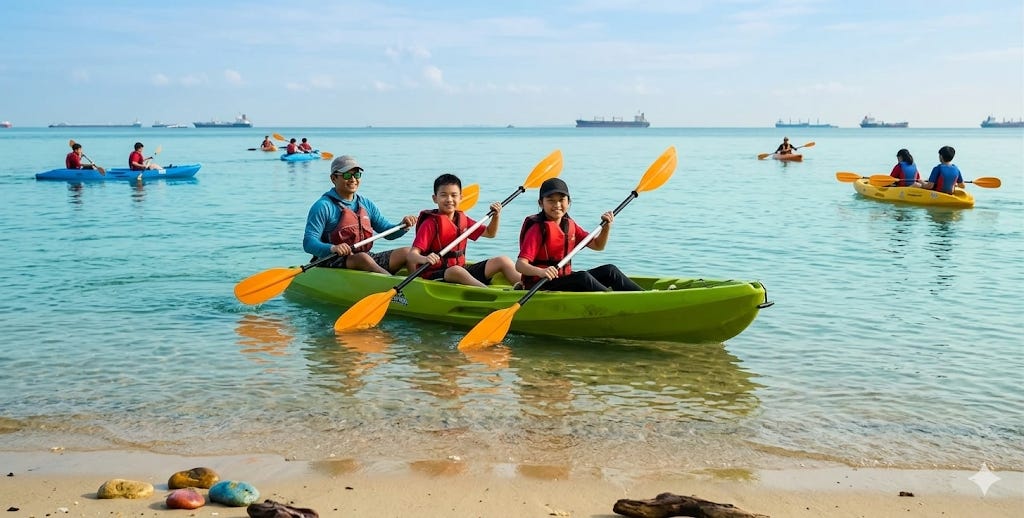
PSLE Oral Practice: Stimulus-Based Conversation (Oreo Method)
Question 1: Look at the picture. How do you think the students in the green kayak are feeling?
Opinion (O): I believe the students in the green kayak are feeling a mixture of excitement and concentration.
Reason (R): This is because kayaking is a thrilling outdoor activity, but it also requires them to focus hard on their coordination so they don’t capsize or go off course.
Example (E): In the picture, the boy and girl are smiling, which shows they are enjoying the sun and the sea. However, they are also gripping their paddles firmly and looking straight ahead, showing that they are taking the instructor’s advice seriously.
Opinion (O): Therefore, while they are having a lot of fun, they are also very focused on working together as a team.
Question 2: Have you ever tried a water sport or a challenging outdoor activity?
Opinion (O): Yes, I have tried dragon boating during a school learning journey last year, and it was quite an intense experience.
Reason (R): It was challenging because it required all twenty of us to row in perfect timing to the beat of a drum, which was much harder than it looked.
Example (E): For instance, halfway through the session, my arms started to ache and I wanted to stop. But when I saw my teammates pushing through their tiredness, I felt motivated to keep rowing until we reached the finishing line.
Opinion (O): In the end, I felt a great sense of accomplishment, and it taught me the true meaning of “one boat, one heartbeat.”
Question 3: Do you think outdoor activities like kayaking help to build a student’s character?
Opinion (O): I strongly agree that outdoor activities like kayaking play a vital role in building a student’s character.
Reason (R): These activities put students in unfamiliar environments where they must develop resilience and learn how to communicate effectively with others to solve problems.
Example (E): For example, if a pair of students is struggling to paddle against the current, they cannot give up. They must talk to each other, synchronise their strokes, and encourage one per another to reach the shore. This builds grit and teamwork.
Opinion (O): Thus, these experiences are essential for developing well-rounded students who are prepared for challenges in the real world.