


📖 Reading Passage
168 words
The school’s innovation hub was a hive of activity. Everywhere you looked, Primary Six students were deeply engrossed in their robotics projects. On a long wooden table, a group of children worked together to navigate a sleek, white robot dog through a complex obstacle course made of colorful blocks. They tilted their heads, eyes fixed on the mechanical pet, as they carefully manipulated the joysticks on their remote controls.
Nearby, a safety net reached from the floor to the ceiling. Inside the enclosure, two small drones hummed like giant dragonflies, dipping and diving through glowing neon hoops.
“Steady now,” whispered a girl, her finger hovering over the tablet screen. “If we adjust the altitude slightly, the drone will glide through the final ring perfectly!”
As the drone soared through the target, her teammates erupted into spontaneous applause. Their teacher, Mr. Tan, watched with a proud smile, knowing that these hands-on experiences were preparing them to be the innovators of tomorrow.
PSLE Oral Practice: Stimulus-Based Conversation (Oreo Method)
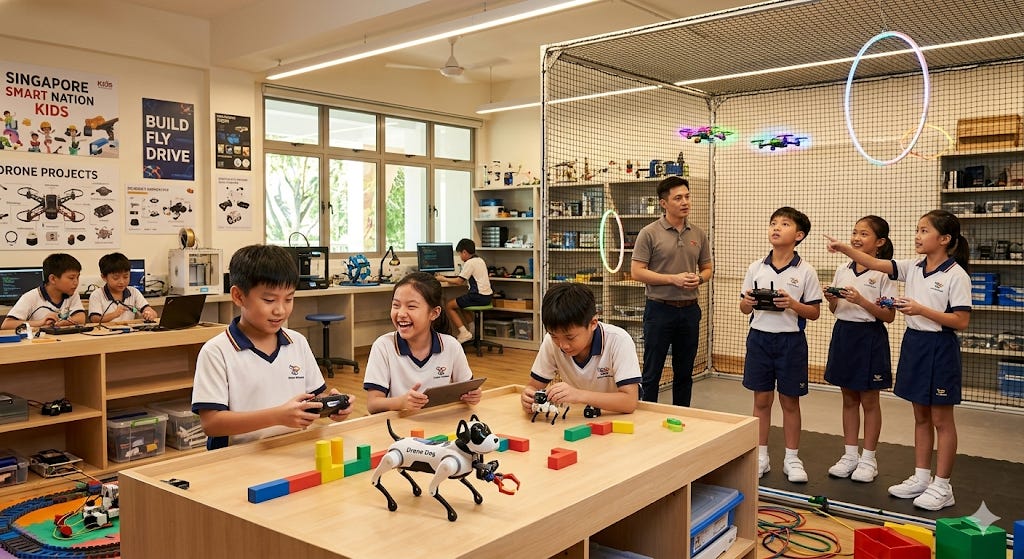
Question 1: Look at the picture. Would you like to spend your recess in a room like this?
Opinion (O): I would definitely choose to spend my recess in this innovation hub because it looks like a fun and intellectually stimulating environment.
Reason (R): Instead of just sitting in the canteen, I could practice my problem-solving skills by navigating the robot dogs or flying the drones through the hoops.
Example (E): In the picture, the students are smiling and working together. This shows that robotics isn’t just about machines; it is also a social activity where you can bond with friends over a shared challenge, like getting the drone through the final ring.
Opinion (O): Therefore, I think a room like this is the perfect place to relax while still learning something useful and modern.
Question 2: Do you think technology makes learning easier or more difficult for students?
Opinion (O): In my view, technology definitely makes learning much easier and more engaging for students today.
Reason (R): It allows us to visualize complex concepts that are hard to understand just by reading a textbook.
Example (E): For instance, when learning about aerodynamics, actually flying a drone—as seen in the enclosure in the picture—helps us see how wind and balance work in real-time. If we make a mistake, we can immediately adjust our code or our remote control, which is a very effective way to learn from errors.
Opinion (O): In conclusion, while there is a learning curve, technology provides us with the tools to understand the world in a much more practical way.
Question 3: Some people say that children spend too much time on “screens” and gadgets. What is your opinion?
Opinion (O): I believe that while too much “mindless” screen time is bad, “productive” screen time like what we see in the picture is actually very beneficial.
Reason (R): There is a huge difference between scrolling through social media for hours and using a tablet to code a robot or pilot a drone.
Example (E): For example, the students in the innovation hub are using their devices as tools to create and innovate. They are developing critical thinking and “Smart Nation” skills that will be essential for their future careers in a digital world.
Opinion (O): Thus, as long as there is a healthy balance between digital activities and physical exercise, I think gadgets are a positive force in a child’s development.