


📖 Reading Passage
188 Words
The computer lab was filled with the rhythmic clicking of keyboards and a palpable sense of curiosity. On the large interactive screens at the front of the room, colorful diagrams of neural networks and data sets replaced the usual geography maps. Today, the Primary Six students were not just users of technology; they were learning to understand the “brain” behind the machine—Artificial Intelligence.
“Look at this!” Wei Han exclaimed, pointing enthusiastically at his monitor. “I fed the program fifty different images of cats and dogs, and now the algorithm can accurately distinguish between them on its own. It is actually learning from the data I provided!”
His teacher, Mrs. Lee, leaned over to get a closer look, her professional attire a sharp contrast to the students’ white uniforms. “That is exactly right, Wei Han,” she said with a nod of approval. “AI is like a digital apprentice. It requires high-quality information to develop its intelligence. You are essentially teaching it how to think.”
As the lesson progressed, the students began to realize that while AI was incredibly powerful, it still relied on human creativity and ethics to function correctly.
PSLE Oral Practice: Stimulus-Based Conversation (Oreo Method)
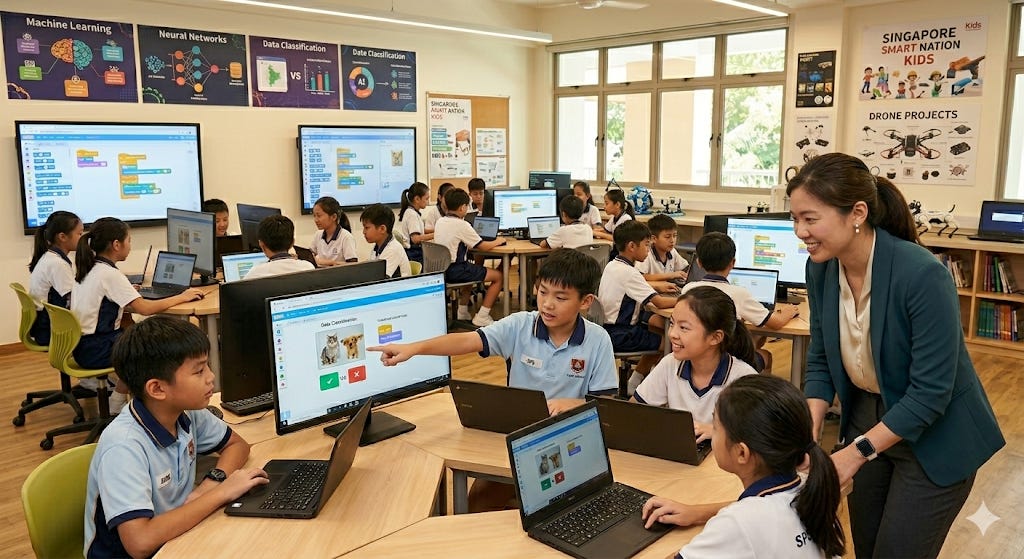
Question: How do you think AI will change the way you do your homework in the future?
Opinion (O): I believe that AI will act as a highly personalized tutor that makes doing homework more efficient and less frustrating.
Reason (R): AI can analyze the areas where a student is struggling and provide specific explanations or practice questions tailored just for them.
Example (E): For instance, if I am stuck on a difficult math problem, an AI assistant could break down the steps for me instead of just giving me the answer. This helps me understand the logic behind the solution so I can solve similar problems on my own later.
Opinion (O): In conclusion, AI will transform homework from a repetitive task into a more interactive and supportive learning experience.
Question 2: Do you think a robot or an AI could ever replace a teacher in the classroom?
Opinion (O): In my opinion, while AI is a powerful tool, it can never fully replace a human teacher.
Reason (R): This is because teaching is not just about delivering information; it involves empathy, encouragement, and understanding a student’s emotions.
Example (E): For instance, in the picture, Mrs. Lee is leaning in to give Wei Han a nod of approval. A robot might be able to check if his code is correct, but it cannot truly feel proud of his progress or inspire him to keep trying when he feels frustrated. A teacher knows how to build a relationship with their students, which is something a machine cannot do.
Opinion (O): Therefore, I believe AI should be used to assist teachers, but the “human touch” will always be necessary for a good education.
Question 3: Some people worry that AI will make students “lazy” because they will stop thinking for themselves. What is your view?
Opinion (O): I disagree with the idea that AI will make us lazy; instead, I think it will challenge us to think at a higher level.
Reason (R): When AI handles the repetitive or simple tasks, students can focus their energy on being creative and solving more complex problems.
Example (E): For example, instead of spending hours manually sorting data, a student can use an algorithm to do it in seconds. This gives them more time to ask “Why is this happening?” or “How can we use this information to help society?” As seen in the picture, the students are learning how the technology works, which requires a lot of critical thinking and effort.
Opinion (O): In conclusion, as long as we are taught to use AI responsibly and ethically, it will act as a “brain booster” rather than a shortcut to laziness.