


Reading Passage:
178 words
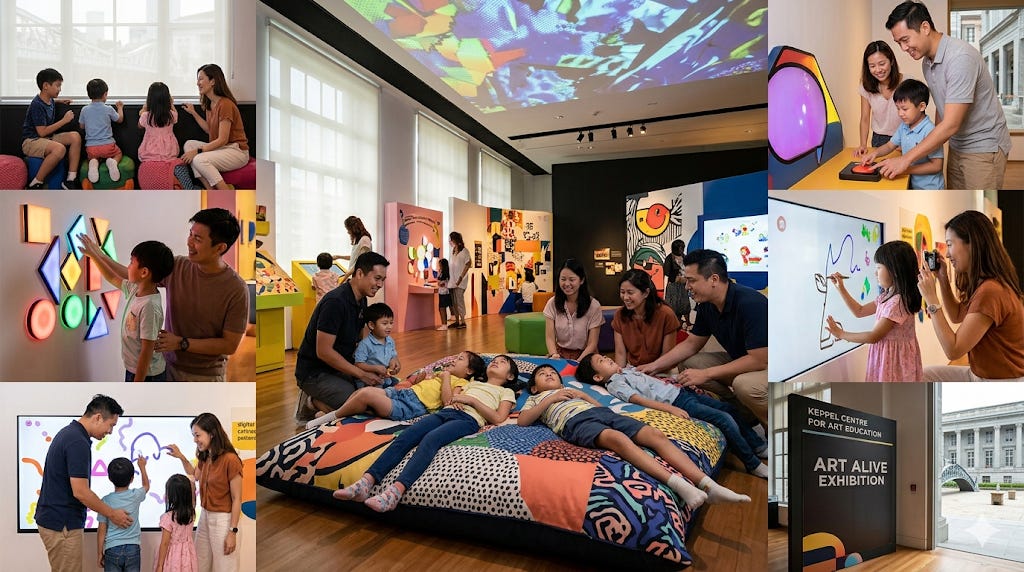
Stepping into the grand halls of the National Gallery, I felt as though I had entered a magical realm where imagination knew no bounds. The “Art Alive” exhibition was unlike any museum I had ever visited. Instead of static paintings hanging silently on white walls, the artwork pulsed with vibrant energy and light.
My parents and I stood in awe as a giant digital canvas reacted to our movements, swirling with colors whenever we walked past. In the Keppel Centre for Art Education, my younger sister giggled with delight as she used a digital wand to “paint” onto a massive glowing screen. It was incredible to see how technology could breathe new life into traditional masterpieces, making them accessible and exciting for children like us. As we explored the interactive stations, I realized that art was not just something to be looked at from a distance. It was an experience to be shared, felt, and created. By the time we left, my mind was buzzing with new ideas and a newfound appreciation for the endless possibilities of creativity.
PSLE Oral Practice: Stimulus-Based Conversation (Oreo Method)
Question 1:
Q: Based on the picture and passage, would you be interested in visiting the “Art Alive” exhibition?
O (Opinion): I would be extremely keen to visit the “Art Alive” exhibition at the National Gallery.
R (Reason): This is because I find interactive art much more engaging than traditional galleries, as it allows me to be part of the artwork rather than just an observer.
E (Example): For instance, I love the idea of using a digital wand to “paint” on a screen. It reminds me of the team-bonding activities I do in school where we collaborate to create something visual. I think seeing my own movements reflected in the digital canvas would be a very memorable experience.
O (Opinion): Therefore, I believe this exhibition is a perfect way to spend a school holiday because it makes learning about art fun and exciting.
Question 2:
Q: Do you think using technology, like digital screens and sensors, helps children appreciate art better?
O (Opinion): In my view, technology is a powerful tool that definitely helps my generation appreciate art more deeply.
R (Reason): Many children find traditional museums a bit intimidating or “boring” because they have to be very quiet and cannot touch anything. Technology removes that barrier.
E (Example): For example, if a child sees a famous painting come to life through animation or high-tech lighting, they might become curious about the history behind it. It acts as a “bridge” that connects old masterpieces with the modern, digital world we live in today.
O (Opinion): Thus, I feel that integrating technology is a smart move to ensure that art remains relevant and interesting for young people.
Question 3:
Q: Besides visiting museums, what are some other ways families can encourage creativity at home?
O (Opinion): I believe families can encourage creativity by setting aside “gadget-free” time to work on hands-on projects together.
R (Reason): Creativity flourishes when we are forced to think out of the box using simple materials we find around the house.
E (Example): For instance, my parents and I once spent an entire afternoon building a “recycled city” out of old cereal boxes and plastic bottles. We had to brainstorm how to make the structures stable and how to decorate them. It was not only a great way to bond, but it also taught me that you don’t need expensive tools to be an artist.
O (Opinion): So, I think that by encouraging curiosity and play at home, parents can help their children develop a lifelong love for creativity.