


Reading Passage:
160 words
Every Saturday morning, the Tan household is a hive of activity. Instead of sleeping in or playing video games, Wei Ming and his younger sister, Shanti, gear up for their weekly “Mission Clean-Up.” Their mother believes that a home is a shared space, and therefore, its upkeep should be a shared responsibility.
Wei Ming is in charge of the heavier tasks. He handles the vacuum cleaner with precision, ensuring not a single speck of dust remains under the sofa. Meanwhile, Shanti takes pride in organizing the bookshelf and wiping down the dining table until it gleams. Even though the work can be tiring, the siblings often turn it into a game, seeing who can complete their chores the fastest.
By noon, the flat is spotless and smells of fresh lemon detergent. Their parents always reward their hard work with a delicious home-cooked lunch. Through these simple chores, Wei Ming and Shanti have learned that cooperation makes any task easier and that contributing to the family is truly rewarding.
PSLE Oral Practice: Stimulus-Based Conversation (Oreo Method)
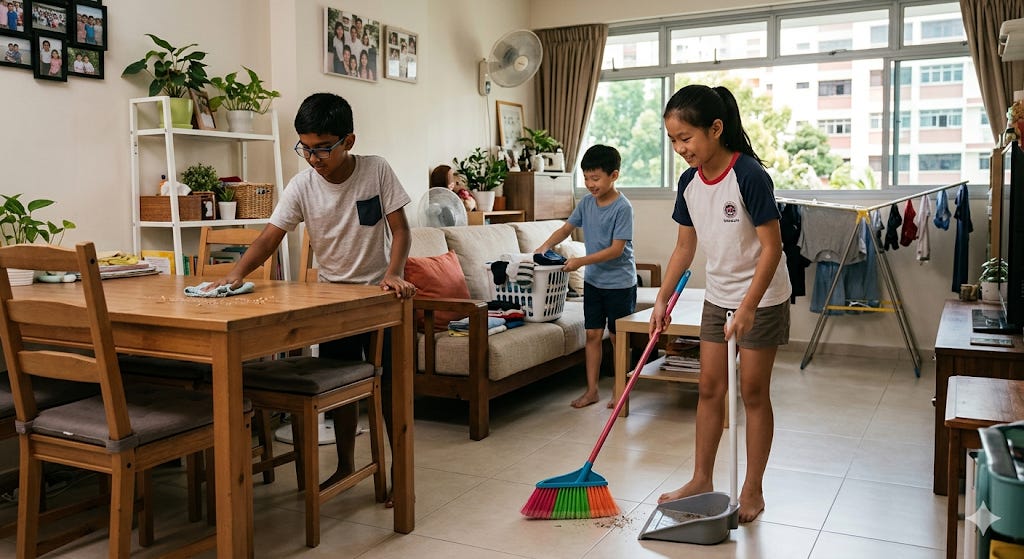
Q1. Describe what is happening in this picture. A: In this picture, I see three children tidying up a living room. A girl in the foreground is sweeping the floor and collecting dirt into a dustpan. Next to her, a boy is wiping the dining table with a cloth. In the background, a younger boy is folding clothes from a laundry basket. They are all smiling and appear happy to help.
Q2. Why is it important for children to do housework? A: I believe that doing housework is important for children as it helps them develop useful life skills and a sense of responsibility. Furthermore, it allows them to appreciate their parents’ hard work and contribute to the family’s well-being.
Q3. Besides doing chores, what are other ways family members can show care for each other? A: Family members can show care for each other by spending quality time together, such as having meals together or playing games. They can also offer emotional support, listen to each other’s problems, and express love and affection.